TONKAWA: THEY ALL STAY TOGETHER
  • Home
  • About
  • Screenings
  • Contact
  • News

Recent Articles

Austin American-Statesman: Time Seemed to Stand Still: View from Sacred Red Mountain

Yahoo News: Tonkawa leaders return to thankful Austin


Austin 360: Tonkawa tribe returns to Austin for Friendship Day

Austin American-Statesman: Giving thanks for friendship between the Tonkawa, Austin

USA Today: 140 Years After Forced Exile, the Tonkawa Reclaim a Sacred Part of Texas

Austin American-Statesman: Time to Thank the Tonkawa for saving the Capital of Texas

​
Austin American-Statesman: We're Home


​​Texas Highways: The Original Texans

Follow Production

Tonkawa Tribe Purchases Sacred Mountain in Texas

12/21/2023

1 Comment

 
Picture
GUASE, TX.   December 12, 2023. 

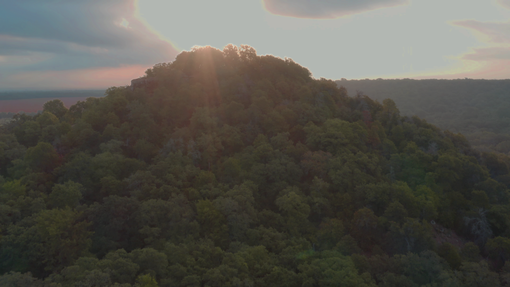
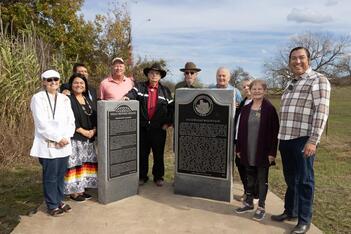
On December 12th, 2023, the Tonkawa Tribe of Oklahoma purchased its place of origin in Central Texas. That place of origin, a mountain named Naton Samox meaning Red Mountain in the Tonkawa language, is the site of the tribe’s original creation story. The sixty acre tract near Gause Texas was purchased from Texas landowners who owned a larger parcel since 1995 containing that mountain. After the necessary preparations are concluded, the tribe will be making the site accessible to the public as a historic park, for public enjoyment of its beauty, as well as to educate the public about the tribe’s Texas history.

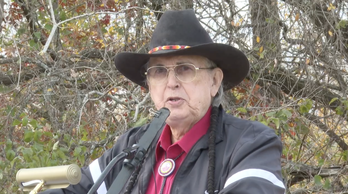
Chief Russell Martin, Secretary/Treasurer Racheal Starr, and Tribal Historian Don Patterson traveled to Texas for the closing of the purchase, taking possession of the land with Red Mountain in view. “I can hardly find words to describe how important this purchase is to our tribe,” said Russell Martin, President of the Tonkawa Tribe. “This past summer when it became clear we had the opportunity to purchase the site, we held a tribal meeting to discuss the situation. When we called for a vote, every hand in the room was raised in favor of the purchase. We felt part of a story that was bigger than all of us. Many eyes had tears.”
Picture
Red Mountain’s place in the tribe’s history is significant in many respects. Its geological formation and color in Central Texas is unusual; its location along ancient trade routes was strategic; it served as a regional navigational landmark; it was a gathering place for seasonal tribal celebrations; and it presided over a large collection of area campsites that provided new homes to many tribes seeking refuge during the difficult days of the Spanish period, often referred to as Rancheria Grande.
​
While the Tonkawa creation story had been passed down in its oral history for generations, after the tribe’s second and final removal to Oklahoma in 1884, the mountain’s exact location was lost. Using in part the old Spanish records, Donald Patterson rediscovered the mountain’s location in the early 1980s. Key to the rediscovery was the fact that the tribe was often said to reside at the confluence of the Brazos and Little Rivers, near what is today Gause Texas, a 30 minute drive Northwest of Bryan-College Station. Patterson later served multiple terms as President of the Tribe, and is now the oldest living male elder. Patterson has also filled the role of tribal historian for over fifty years.  “This purchase would not have been possible without the effort of Don Patterson,” said Russell Martin. “While his list of accomplishments and his legacy is huge, I have a feeling that Don’s rediscovery of our sacred mountain might one day be considered his most important effort of them all.”

Picture

Once the mountain was rediscovered, the tribe immediately had hopes that the site could be preserved. In July 1986, tribal President Henry Allen spoke to the Austin American Statesman about Red Mountain being the birthplace of the Tonkawa. He also said  “If there's some way we could get that back and make it a state park or a national park or a tribal park, whatever the case may be, we’d like to do that.” In that timeframe, Chief Allen hoped that the state might ultimately spend the money necessary to preserve the site that was so important to the tribe. “You don't take something from someone without offering something in return,” Allen told the paper.

While Chief Allen had called it Red Mountain in 1986, the mountain had been known in Texas by another name for more than one-hundred years: Sugarloaf Mountain.  The name Sugarloaf Mountain was given to the site by the locals because of its similarity to the way that sugar was historically transported as a smooth, round mound of molasses on a flat board. One of the highest points in Milam county, the mountain peak stands 500 feet above sea level, and 250 feet above the Little River that flows by its base. It is clearly visible from thirty miles away, as it looks out upon many square miles of flat Brazos river bottom land, and rich blackland prairie.
​
In 1994, a Texas landowner who owned the mountain as part of a large tract of land was approached by treasure hunters seeking Spanish gold. With the landowners approval, the treasure hunters examined the mountain carefully, but found no minerals of value. Unsatisfied, the landowner began excavating the side of the mountain himself in a haphazard, irresponsible manner, to the dismay and outcry of local residents. Then Tribal President Virginia Combrink learned of the destruction of the mountain and visited Gause, writing ​open letters to local newspapers and calling on local residents to pressure the landowner to stop the mountain’s destruction. One week later, the digging stopped, but the mountain still bears the scars of the excavations. Having seen the mountain both before and after the destruction, Don Patterson describes the Red Mountain today as being like an apple with a bite taken out of it.
In 2022, the Herzog’s expressed interest in selling off sixty acres of their land that included Sugarloaf Mountain to an organization that might want to preserve it and turn it into a local park. Independently in November 2022, two members of a documentary film crew working with the tribe invited President Russell Martin to climb the mountain with them, simply for enjoyment. When Russell Martin and the two crew members reached the summit, all climbing it for the first time, a silence fell upon them. Being moved at its beauty Russell Martin broke the silence by saying, “This mountain must be preserved.”

With the blessing of the tribal executive committee, the documentary crew researched the situation and learned of the Herzog’s desire to sell off the mountain. In 2023 the Herzog’s leased sixty acres containing the mountain to El Camino Real de los Tejas National Historic Trail Association (ElCaT), a lease which also included an option to purchase at a previously agreed sales price.
Picture
In 1995 the mountain was sold, this time to new Texas landowners, Leon and Kay Herzog who desired to protect the mountain and the woodlands surrounding it. They had no knowledge that the land might have any connection to an existing indigenous tribe. During the Herzog period of ownership, the locals often visited, considering the place to be of great beauty, and its view remarkable even without any maintained trail to its summit. Students from Texas A&M University were said to visit the site in groups each year. Stories of marriage proposals at the top of the mountain were common. Meanwhile, tribal members often visited the site whenever they made trips to Texas. Some climbed the mountain, but after NO TRESPASSING signs were added as a precaution, most tribal members just viewed the mountain from the public roads. Since Don’s rediscovery, those tribal members who climbed the mountain not only had a wonderful view, but often remarked that it was a place of spiritual reflection – a way to feel closer to their ancestors who had also climbed the summit for many generations. But since 1995 no direct contact was made between the Tonkawa Tribe and the Herzog’s, who had no knowledge of the tribal members’ interest in the site.

The tribe then approached Steven Gonzales, executive director of ElCaT, and learned that ElCaT would be willing to forgo its lease and allow the tribe to purchase the site in its entirety.  The tribe also realized that ElCaT could become an excellent partner to manage the site locally, and had great expertise in working with Texas landowners to develop historic parks. Once a management agreement was put in place between the tribe and ElCaT, all that was left was the completion of the sale between the Herzog’s and the tribe. This sale was arranged by broker and Sugarloaf advocate Dave Cunningham, who lived nearby and had long dreamed that the mountain could become a park.

For the last eighteen months, the tribe has been working to produce a film that would tell their unusual story in a feature-length documentary format.  The tribe, together with Sugarloaf Pictures’ director Andrew C. Richey, producer Bob O’Dell, and executive producer Felipe Adams, have been capturing the evolving story of the mountain and its purchase on film. The film, Tonkawa: They All Stay Together, has an expected release date of 2025.

Red Mountain is the first piece of Texas land ever purchased by the Tonkawa Tribe. The tribe has agreed to preserve and protect the land in perpetuity, and will work with ElCaT to open up the site for public access as soon as the needed preparations are complete.
1 Comment
Mitch
5/25/2024 09:38:51 am

I spend a lot of my time doing meditation at Red Mountain. When Im there the spiritual presence always falls on me. I so happy for the Tonkawa Tribe having there home back and look forward to a time of celebration with them. Welcome Home

Reply

Your comment will be posted after it is approved.


Leave a Reply.

Find us on Social Media
Picture
Picture
© 2020-25 Sugarloaf Pictures, LLC
  • Home
  • About
  • Screenings
  • Contact
  • News